Physiognomy
From a mood board to a design direction.
- source
- GitHub ↗
After Lorraine Daston’s Cloud Physiognomy: describing what flummoxes description.
Lorraine Daston, “Cloud Physiognomy”, Representations 135, 2016.
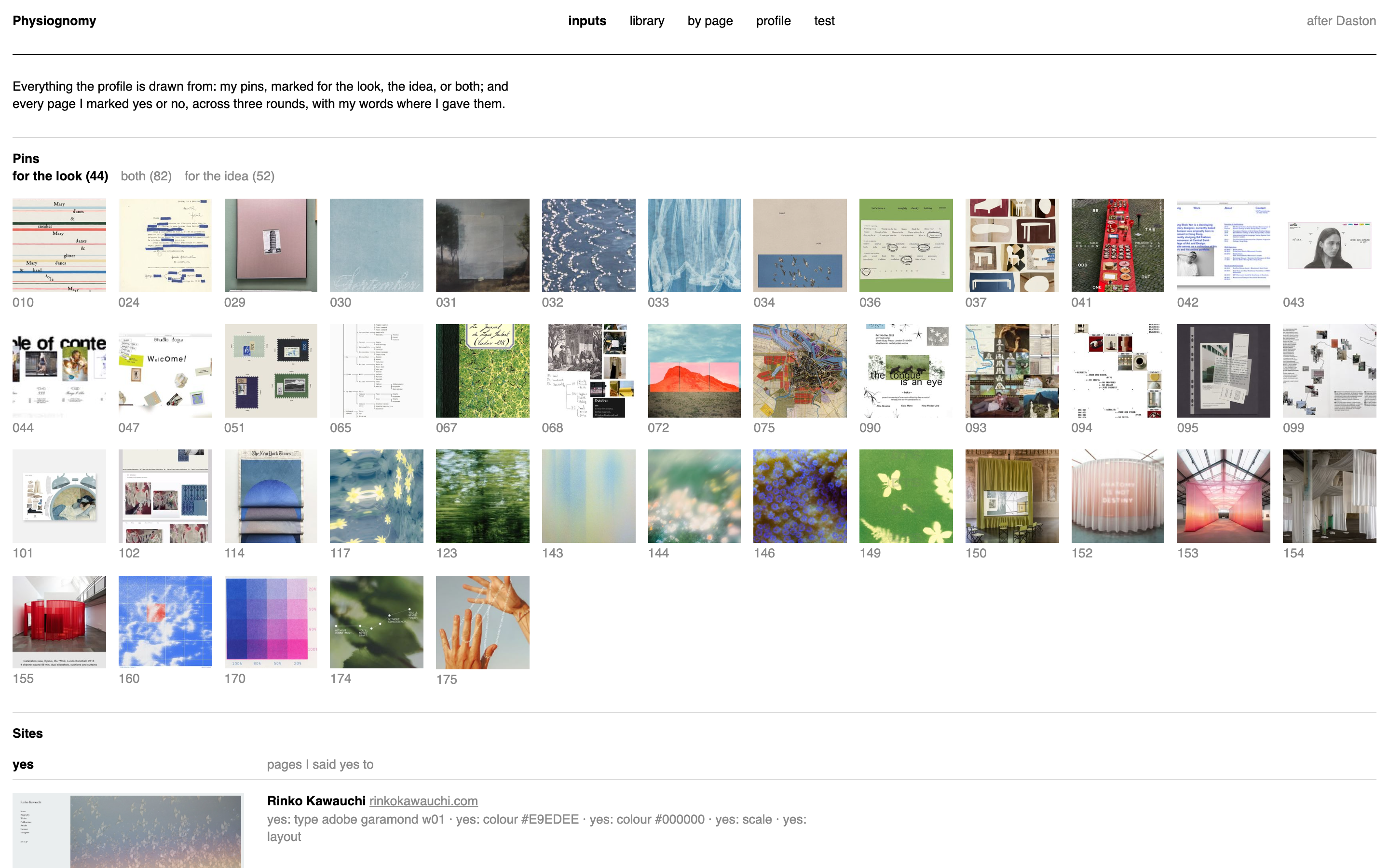
It learns my visual taste from references I like and dislike, and writes it down as a profile agents read before they make anything visual. After PseudoClient (Lin and Martelaro, 2021): learn by example, from a handful, by juxtaposition.
David Chuan-En Lin and Nikolas Martelaro, “Learning Personal Style from Few Examples”, ACM DIS 2021.
The initial direction: BJP-GU, Taste Profiler (POC) (2026). GitHub.
In Physiognomy, taste isn’t a mean. It’s an assemblage, in Deleuze and Guattari’s sense: a whole made of unlike parts that work together without fusing into one thing. Some things belong to my taste only in the company they keep, and an average dissolves exactly that company. So the profile keeps groups that hold together, and the edges where they stop, never an average.
Gilles Deleuze and Félix Guattari, A Thousand Plateaus (1980; trans. Brian Massumi, 1987). University of Minnesota Press.
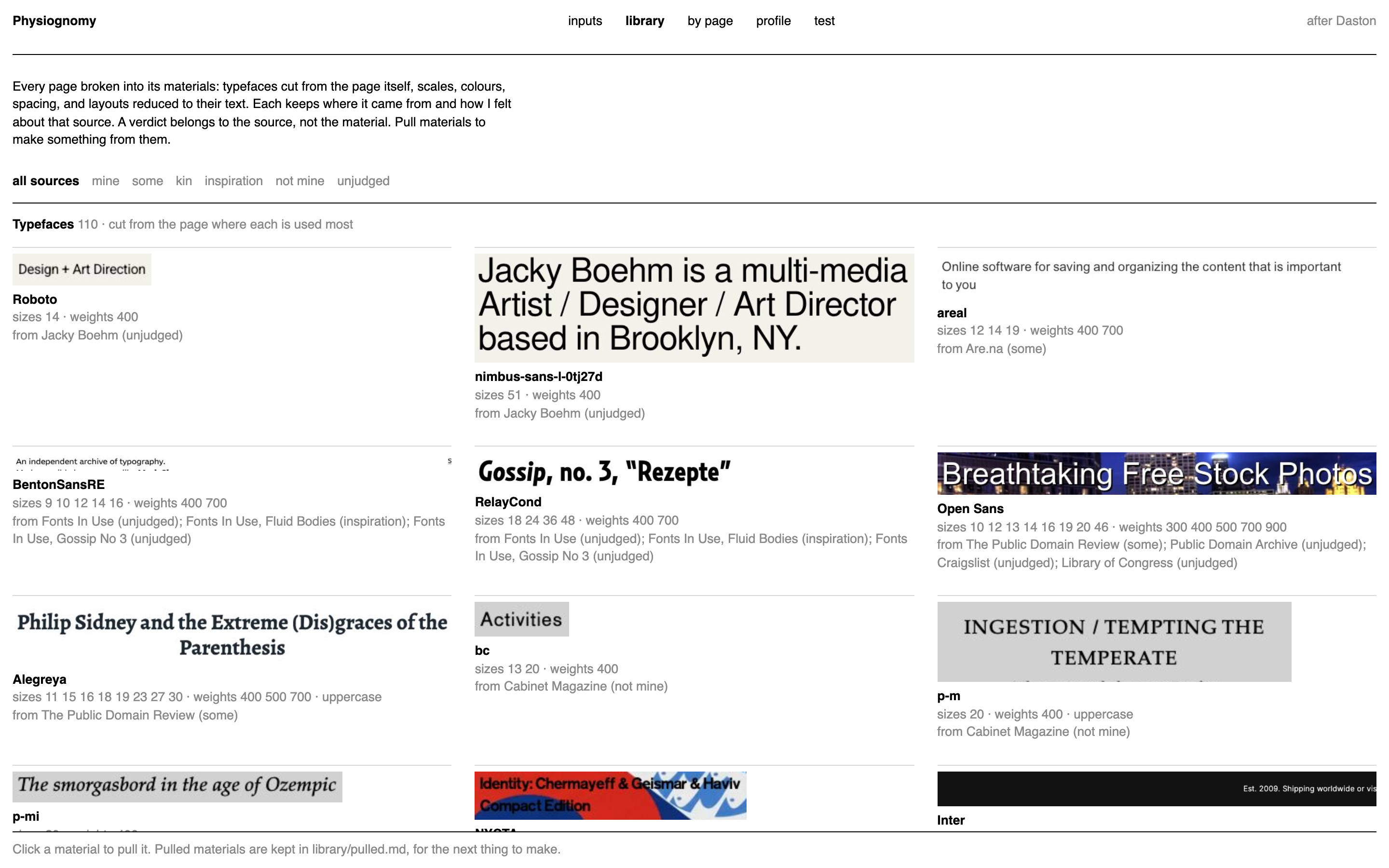
It breaks every page into materials (typefaces cut from the page itself, type scales, colours, spacing, layouts), each kept with where it came from. This follows DeLanda’s account of assemblages: a part keeps its own properties, so it can be taken out of one whole and plugged into another, where it works differently. A new design pulls a few materials across sources, on purpose, and records what it pulled.
Manuel DeLanda, A New Philosophy of Society: Assemblage Theory and Social Complexity (2006). Bloomsbury.